Powder Clutch Brake Systems - Precision Electromagnetic Torque Control Solutions

All Categories

powder clutch brake

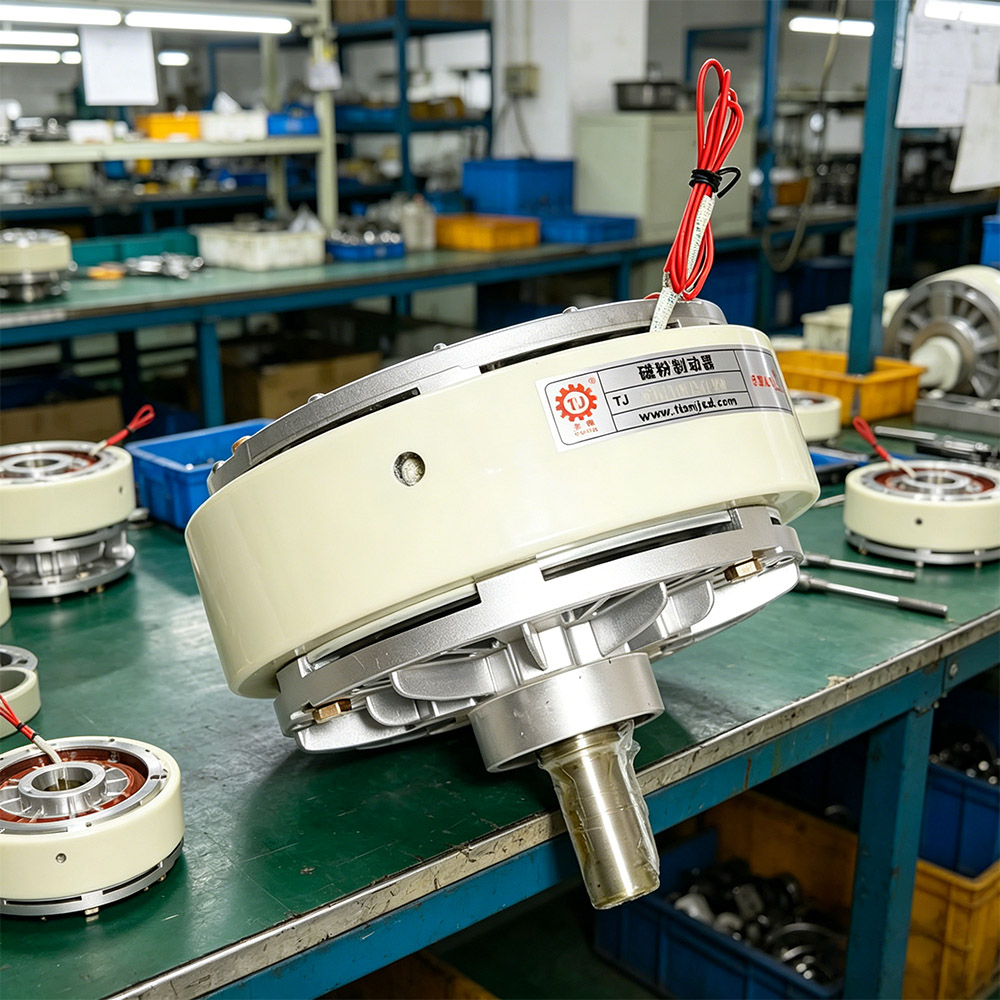
The powder clutch brake represents an advanced electromagnetic control device that utilizes magnetic powder as the transmission medium to achieve precise torque control and braking functionality. This sophisticated mechanism operates on the principle of magnetic field interaction with fine metallic particles, creating variable resistance that enables smooth engagement and disengagement of rotational force. The powder clutch brake system consists of several essential components including an electromagnetic coil, magnetic powder chamber, input shaft, output shaft, and cooling apparatus. When electrical current flows through the coil, it generates a magnetic field that causes the metallic powder particles to align and solidify, forming a coupling between the rotating elements. The strength of this coupling directly correlates with the magnitude of the applied current, allowing operators to achieve infinitely variable torque transmission from zero to maximum capacity. This technology finds extensive implementation across numerous industrial sectors including printing machinery, packaging equipment, textile manufacturing, wire processing, tension control systems, and material handling applications. The powder clutch brake excels in situations requiring precise speed regulation, constant tension maintenance, or accurate positioning control. Manufacturing facilities benefit significantly from its ability to provide stepless torque adjustment without mechanical wear associated with traditional friction-based systems. The operational temperature range typically spans from negative twenty to positive eighty degrees Celsius, making it suitable for diverse environmental conditions. Modern powder clutch brake designs incorporate advanced heat dissipation features to ensure consistent performance during prolonged operation cycles. The response time of these devices measures in milliseconds, enabling rapid adjustments to changing operational demands. Installation simplicity represents another notable characteristic, as these units can be retrofitted into existing machinery with minimal modifications to surrounding components.

New Product Releases

Choosing a powder clutch brake for your industrial applications delivers numerous practical benefits that directly impact operational efficiency and cost management. First and foremost, these devices provide exceptional control precision that traditional mechanical systems simply cannot match. You can adjust torque transmission with remarkable accuracy, responding instantly to changing production requirements without stopping your machinery. This continuous adjustability means your operators can fine-tune performance parameters in real-time, optimizing product quality and reducing material waste. The elimination of mechanical friction points translates into dramatically reduced maintenance requirements compared to conventional clutch and brake systems. Your maintenance teams will spend less time replacing worn components and more time focusing on productive tasks. The powder clutch brake operates with minimal physical contact between moving parts, which means fewer breakdowns and longer service intervals between inspections. This reliability directly contributes to increased uptime and production capacity for your facility. Energy efficiency represents another compelling advantage, as these systems only consume power proportional to the torque being transmitted. During idle periods or light-load conditions, your energy costs decrease accordingly, contributing to lower operational expenses over time. The smooth engagement characteristics prevent sudden jolts or vibrations that can damage delicate products or cause premature wear on connected machinery. Your production line operates more quietly and smoothly, creating a better working environment for employees while extending the lifespan of peripheral equipment. Installation and integration prove straightforward, requiring minimal modifications to existing systems. Your engineering team can implement these devices quickly, reducing downtime during upgrades or replacements. The compact design occupies less space than equivalent mechanical systems, freeing up valuable floor area for additional equipment or improved workflow layouts. Temperature stability ensures consistent performance across varying environmental conditions, maintaining operational reliability regardless of seasonal changes or process-generated heat. The powder clutch brake responds rapidly to control signals, enabling precise synchronization with automated systems and programmable controllers. Your facility gains enhanced automation capabilities without investing in complex mechanical linkages or additional control hardware. These devices generate minimal electromagnetic interference, ensuring compatibility with sensitive electronic equipment and instrumentation commonly found in modern manufacturing environments.

Practical Tips

Transmission Pain Points in Printing/Textile/Chemical Machinery: How Electromagnetic Clutches Improve Equipment Stability?

08

Dec

Transmission Pain Points in Printing/Textile/Chemical Machinery: How Electromagnetic Clutches Improve Equipment Stability?

Struggling with transmission instability in printing, textile, or chemical machinery? TJ-A electromagnetic clutches eliminate slip, boost throughput 15–20%, and ensure asbestos-free safety. Discover how top global manufacturers achieve 99.8% reliability—request a spec sheet today.
View More
High-Quality Web Guide Control Systems From a Leading Domestic Manufacturer With 20 Years of Expertise

08

Dec

High-Quality Web Guide Control Systems From a Leading Domestic Manufacturer With 20 Years of Expertise

Discover high-precision web guide control systems from a trusted domestic manufacturer with 20 years of R&D expertise. Reduce waste, boost efficiency, and ensure reliability. Request a quote today.
View More
The Pain of Non-Standard Transmission in Special Working Conditions

09

Apr

The Pain of Non-Standard Transmission in Special Working Conditions

Struggling with standard transmission failures in extreme temps, dust, or tight spaces? TianJi’s 20-year R&D delivers reliable custom clutches & brakes—engineered for your exact specs. Get a free technical consultation today.
View More

Get Your Custom Quote

Tell us your requirements and get a tailored solution for your project.
Name
Mobile
Email
Please include
Message
0/1000

powder clutch brake

Superior Torque Control with Infinitely Variable Adjustment Capability

Superior Torque Control with Infinitely Variable Adjustment Capability

The powder clutch brake delivers unparalleled torque control precision through its unique electromagnetic powder coupling mechanism, setting it apart from traditional mechanical transmission devices. This exceptional control capability stems from the fundamental operating principle where magnetic field strength directly determines the degree of powder particle alignment and consequent torque transmission. When you apply electrical current to the electromagnetic coil, the magnetic powder particles within the coupling chamber respond by forming chain-like structures along magnetic flux lines, creating a solid coupling medium between input and output shafts. The remarkable aspect of this technology lies in its proportional response characteristics, meaning the transmitted torque increases linearly with applied current, providing predictable and repeatable performance across the entire operating range. This infinitely variable adjustment capability enables your operators to establish precise tension levels in web processing applications, maintain constant speed ratios in variable load conditions, or implement sophisticated motion control sequences without mechanical complexity. The absence of discrete engagement steps eliminates the jerky transitions associated with stepped transmissions, ensuring smooth acceleration and deceleration profiles that protect delicate materials and reduce mechanical stress on connected equipment. Your production processes benefit from microsecond-level response times, allowing the powder clutch brake to react instantaneously to feedback signals from tension sensors, speed encoders, or load cells. This rapid response capability proves essential in applications such as printing registration control, wire drawing operations, or precision positioning systems where timing accuracy directly affects product quality. The system maintains consistent torque characteristics regardless of speed differential between input and output shafts, unlike friction-based clutches that experience performance variations due to heat buildup or surface condition changes. This speed-independent torque transmission ensures reliable operation whether your machinery operates at maximum throughput or crawls through setup procedures at minimal speeds. The powder clutch brake achieves this performance without requiring external lubrication systems, eliminating contamination risks in clean manufacturing environments and reducing maintenance complexity.
Extended Service Life Through Minimal Wear Design Philosophy

Extended Service Life Through Minimal Wear Design Philosophy

The powder clutch brake achieves exceptional longevity by fundamentally eliminating the mechanical wear mechanisms that plague conventional friction-based clutch and brake systems, representing a significant advancement in industrial drive technology. Traditional devices rely on physical contact between rotating surfaces, where friction generates the necessary torque transmission or braking force but simultaneously produces heat and material degradation that inevitably leads to performance deterioration and component replacement. In contrast, the powder clutch brake employs magnetic field manipulation of metallic particles suspended within the coupling chamber, creating torque transmission through electromagnetic forces rather than mechanical friction. This contactless operating principle means that engagement and disengagement cycles occur without abrading surfaces or generating particulate contamination, preserving component integrity throughout extended operational periods. Your facility benefits from dramatically reduced maintenance schedules, as the primary wear items consist only of bearings supporting the rotating shafts and seals protecting the powder chamber from environmental contamination. The magnetic powder itself exhibits remarkable durability, maintaining its magnetic properties and particle size distribution through millions of operational cycles without significant degradation. Manufacturers typically specify powder replacement intervals measured in years rather than months, and even then, replacement often occurs as preventive maintenance rather than necessity due to performance decline. The electromagnetic coil, when properly designed with adequate thermal management, operates reliably for decades without requiring rewinding or replacement. This exceptional durability translates directly into lower total cost of ownership, as your purchasing budgets allocate fewer resources to replacement parts and your production schedules experience fewer interruptions for maintenance activities. The consistent performance characteristics throughout the device's service life mean that your quality control parameters remain stable, eliminating the gradual drift in tension levels or speed regulation that occurs as friction surfaces wear in conventional systems. Environmental factors that severely impact traditional clutches, such as moisture, dust, or temperature fluctuations, have minimal effect on powder clutch brake performance due to the sealed construction and non-mechanical operating principle.
Seamless Integration with Modern Automation and Control Systems

Seamless Integration with Modern Automation and Control Systems

The powder clutch brake excels in contemporary manufacturing environments through its inherent compatibility with digital control systems, programmable logic controllers, and sophisticated automation architectures that define modern industrial operations. This seamless integration capability results from the direct electrical control interface, where simple voltage or current signals from your automation system immediately translate into precise mechanical responses without requiring intermediate conversion mechanisms or complex linkages. Your control engineers can implement advanced regulation algorithms, feedback control loops, or synchronized multi-axis coordination schemes by simply programming appropriate output signals to the powder clutch brake driver electronics. The linear relationship between control current and transmitted torque simplifies controller tuning procedures, as proportional-integral-derivative parameters can be optimized using standard methodologies without accounting for nonlinear friction characteristics or backlash compensation. This predictable behavior enables your automation systems to achieve tighter control tolerances, improving product consistency and reducing rejection rates in quality-critical applications. The powder clutch brake operates effectively across wide bandwidth ranges, responding accurately to both slowly varying control signals during steady-state production and rapid command changes during transient conditions such as web breaks, material splices, or emergency stops. This versatility allows a single device type to address diverse control requirements throughout your facility, simplifying spare parts inventory and cross-training maintenance personnel. The electromagnetic operating principle generates minimal electrical noise, preventing interference with sensitive instrumentation or communication networks operating in proximity to the drive system. Your facility can deploy powder clutch brakes near precision measurement equipment, vision inspection systems, or wireless network infrastructure without experiencing the electromagnetic compatibility challenges associated with brush-type motors or switching power converters. The compact mechanical envelope and flexible mounting configurations facilitate integration into space-constrained machinery designs, enabling equipment manufacturers to optimize overall system layouts without compromising accessibility for service procedures. Standard driver electronics accept common industrial control signals including analog voltage ranges, current loops, pulse-width modulation, or digital fieldbus protocols, eliminating the need for custom interface development when connecting to existing automation platforms.
email goToTop