Energy-Efficient Design With Versatile Integration Capabilities
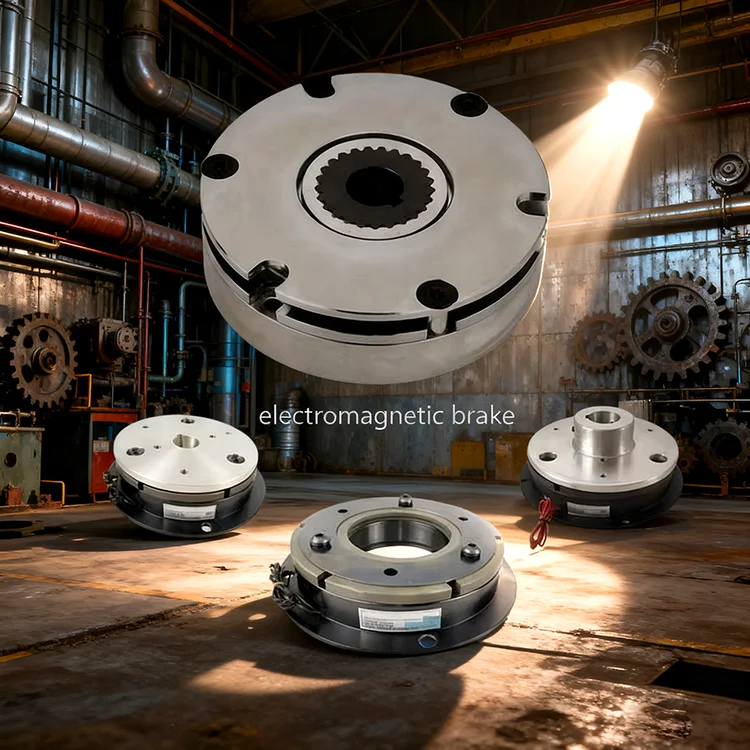
The operational efficiency of electromagnetic power off brakes delivers tangible economic benefits while their flexible design accommodates diverse integration requirements across multiple industries and applications. From an energy consumption perspective, these devices present a compelling advantage because they require electrical power only during the released state when motion is desired. The electromagnetic coil draws current to generate the magnetic field that compresses springs and disengages the friction surfaces, but this represents a small fraction of total operating time in many applications. During holding periods, emergencies, or power-off conditions, the brake maintains full holding torque through mechanical spring force without consuming any electrical energy. This contrasts sharply with electromagnetic power-on brake designs that must continuously energize to maintain braking force, resulting in constant power consumption and heat generation. The energy savings accumulate significantly in applications involving frequent start-stop cycles or extended holding periods, reducing operational costs and minimizing thermal load on electrical systems. The compact physical dimensions of electromagnetic power off brakes enable integration into space-constrained installations where alternative braking technologies would prove impractical. Manufacturers offer extensive size ranges and mounting configurations, including flange-mount, foot-mount, and shaft-mount variants that adapt to diverse mechanical arrangements. The standardized interfaces and mounting patterns simplify retrofit applications, allowing facility managers to upgrade existing machinery with enhanced braking capabilities without extensive mechanical modifications. Electrical integration proves equally straightforward, as electromagnetic power off brakes operate on common industrial voltages and accept control signals directly from programmable logic controllers, safety relays, or manual switches. The predictable electrical characteristics, including coil resistance, inductance, and voltage requirements, allow electrical engineers to accurately calculate power supply sizing and protection device ratings during system design phases. The rapid response characteristics of electromagnetic power off brakes complement modern motion control systems that demand precise timing and coordination. The engagement and release times, typically measured in milliseconds, enable tight synchronization with servo drives, variable frequency drives, and other electronic motion controllers. This temporal precision supports advanced manufacturing processes requiring exact positioning and rapid cycle times. The versatile integration extends to environmental adaptability, with specialized versions of electromagnetic power off brakes available for harsh conditions including extreme temperatures, corrosive atmospheres, washdown environments, and explosive atmospheres requiring special certifications. The modular design philosophy adopted by leading manufacturers allows customization of specific parameters such as torque rating, voltage specification, and mounting configuration without redesigning the entire brake assembly, accelerating project timelines and reducing engineering costs.

 EN
EN